
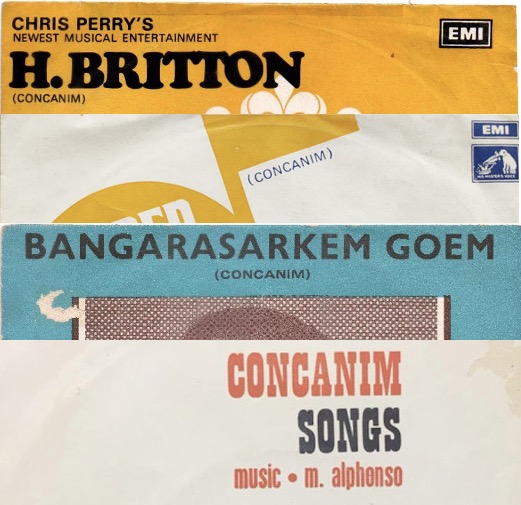
I spent a couple of years trying to track down ‘Konkani Gramophone Records’, a book compiled by Felix Correia and Franklin De Souza. Other than one press release and a blog post where I first heard about the book, there isn’t much information about the book online. When I finally found the book, I wanted to meet the authors behind this incredible body of knowledge. For a record collector like me, who found it difficult to track down ‘Concanim’ records, I was curious to understand how they completed this incredible body of work.
On a gloomy monsoon evening, I spent a few cheerful hours talking with Franklin De Souza and his wife. A Civil Engineer by profession, he lives in Loutolim with his family and his treasured collection of notes on Konkani music. I went to meet him with the intention of learning how the book came about but ended up uncovering a lot more.
From a young age, De Souza would listen to Konkani music on the radio whenever his father, a teacher by profession, tuned in. It was his father that suggested De Souza listen to Alfred Rose, after which he never missed a radio program. He also recalls that his RCC professor in Engineering college had a record collection. From 1969 onwards, he started noting down the names of the songs that were played on All India Radio (local radio station, formerly named Emissora de Goa). He had a notebook where he would write down the name of the song and the singer every time he heard a new one. The book he co-authored with Felix Correia, Konkani Gramophone Records, was published in 2011, four decades later.

Correia, who lived in Bombay, travelled to Goa to meet De Souza with the intention of digitizing and archiving some of the songs that were available only on shellac. De Souza in turn shared a list of songs with Correia asking him to digitize them for archiving as well. That is how they became friends, he says. De Souza jokes that while he is years younger than Correia, as evident by their photographs on the back cover of the book, their love for Konkani music was the same.
Correia, who also had his own list of Konkani song titles, obtained by meeting with record collectors, was impressed with De Souza’s notebook. Correia then approached Tiatr Academy of Goa (TAG), who agreed to publish their compilation in one book.
The music released on shellac and vinyl were by ‘old professionals’ (artistes) said De Souza, and he wanted to keep a track of their work. Records were not commonly found anymore and it made sense to limit his notes to that format. Over time, as cassettes and CDs boomed, the rate at which new songs released increased and De Souza felt he couldn’t keep up with noting down the names. Although, for the first 10 years of the Cassette era, he continued to note down the information of the cassettes released by the same ‘old professionals’ who had transitioned from vinyl to cassette. This also gives us some insight into the cassette culture of the time with many amateurs embracing the then new format to share their music with the world.
De Souza mentioned that he has not heard every single song that is listed in the book since some of the song titles were obtained directly from record collectors. There were a few record collectors who were not keen on sharing the music and they divulged the song titles only. De Souza shared a list of 136 songs he’s never heard yet. In recent years, he has found a few of these elusive songs, originally released on an analog format, on a digital medium like YouTube.
The book was released in a format different to what De Souza and Correia envisioned, and hence they could not call out which songs were released on shellac and which were on vinyl. De Souza also has a list of a few duplicate entries in the book that made it to the final print before the authors could submit a revised draft.
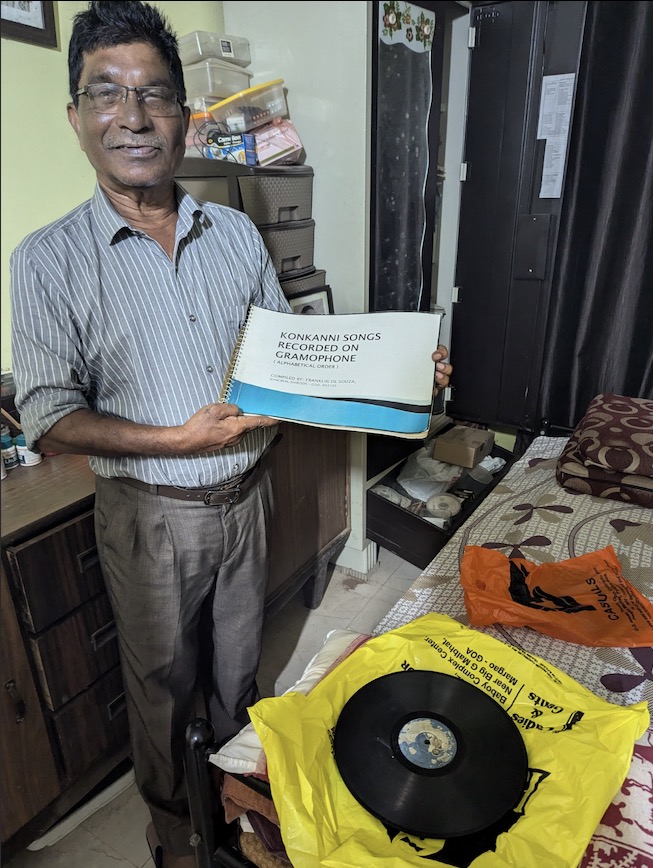
While this book is a valuable resource for researchers today, at the time of compiling it, De Souza did not think of it in that manner. He worked on the book for the love of the music. It was for his satisfaction that he wanted the list of all the Konkani songs, released on shellac and vinyl, to be published so that it survives for centuries (sic).
On 16th December 2011, when the book was launched in the Conference Hall of the Tiatr Academy of Goa, there was a strike in Panjim, and many news reporters didn’t make it to the event, recalled De Souza. That is probably why there is not much press coverage for this book. Despite this lack of coverage though, dedicated researchers have tracked down the book.
Overseas ethnomusicology student, Eduardo Falcão, met with De Souza in 2022 when working on a research paper titled ‘Archiving through listening: the construction of Konkani Gramophone Records Catalogue by Felix Correia and Franklin D’Souza‘. Closer home, Goan ethnomusicologist and documentary filmmaker, Nalini Elvino de Sousa, referred to this book for her Master’s degree project titled ‘KANTAR GOA: CANTARAM ON SHELLAC DISCS AT THE ALL INDIA RADIO ARCHIVE (1947-1965)‘. Nailini, whose latest documentary ‘Kantar Goa‘ focuses on the Tiatr and Cantaram, said “In 2021, when I began my research at the University of Aveiro in Portugal, focusing on the shellac discs archived at All India Radio (AIR), the only information I had were the photos taken at the archive. This book was instrumental in helping me understand that the shellac discs at AIR represent only a fraction of what was recorded by Goans in Bombay. Additionally, it clarified that the term ‘gramophone records’ is not synonymous with shellac discs but refers to all records that can be played on a turntable, including vinyl discs at 33⅓ rpm and 45 rpm”.

Credit: Tanya Tavora
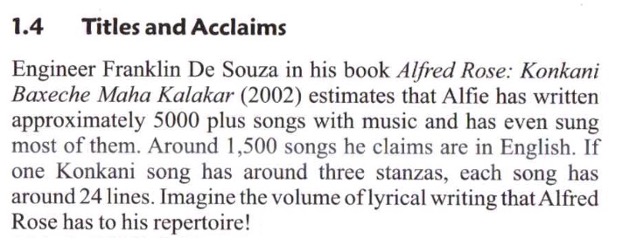
This archival project isn’t the only one De Souza has worked on though. Before Konkani Gramophone Records was published, he self published a booklet in 1996 titled ‘Alfred Rose, Konkanni Palkache Maha Kolakar’. This booklet, in Romi Konkani, is a biography of Alfred Rose.

In his thirties, De Souza exchanged letters with Alfred Rose, Goa’s beloved singer, composer and tiatrist, who lived in Bombay. He has a file of inland letters and typewriter pages of his correspondence with the Melody King of Goa. In one such letter, there is a list of songs where De Souza asked Alfred Rose to confirm if he had also written the lyrics or if he was only the singer to which Alfred Rose replied by marking an X on the songs he had written.

Some of this correspondence was in English and a lot of it was in Romi Konkani too. De Souza asked me to read aloud three paragraphs of one such letter, in Romi Konkani, that was written on a typewriter.
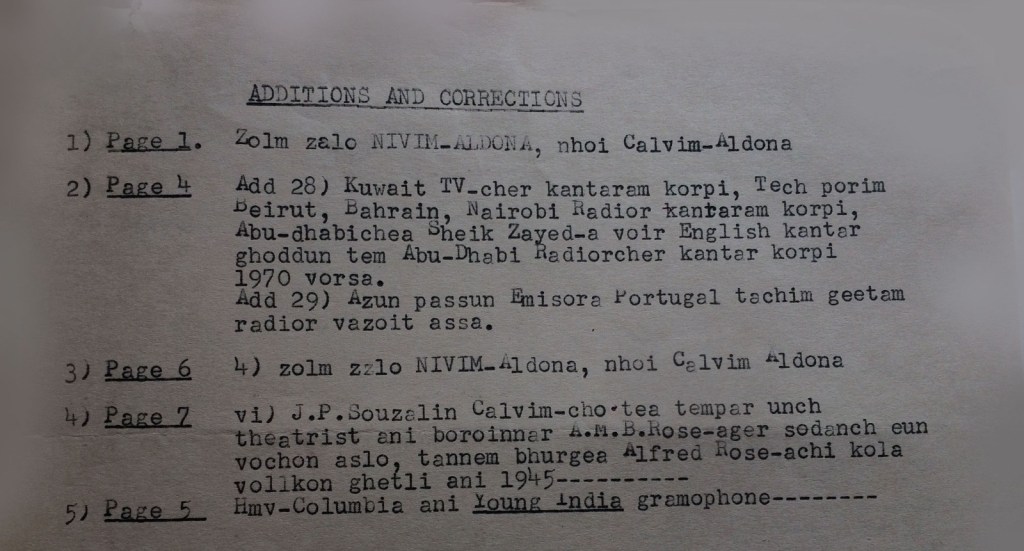
This letter was Alfred Rose’s reply to De Souza sending him the manuscript of the booklet on Alfred Rose’s biography. Alfred Rose wrote that when he opened the letter, he expected the pages to be the script for a tiatr (Konkani music theatre) and was surprised to see that it was the draft of a booklet on his life and achievements, where the sender was asking him to review it for errors. One such error in De Souza’s first draft was that Alfred Rose was born in Calvim, Aldona. To this Alfred Rose replied that he was born in Nivim, Aldona and not Calvim, Aldona, and that it was fellow Tiatrist, J. P . Souzalin who was born in Calvim. Alfred Rose’s Wikipedia page still mentions Calvim as his place of birth.
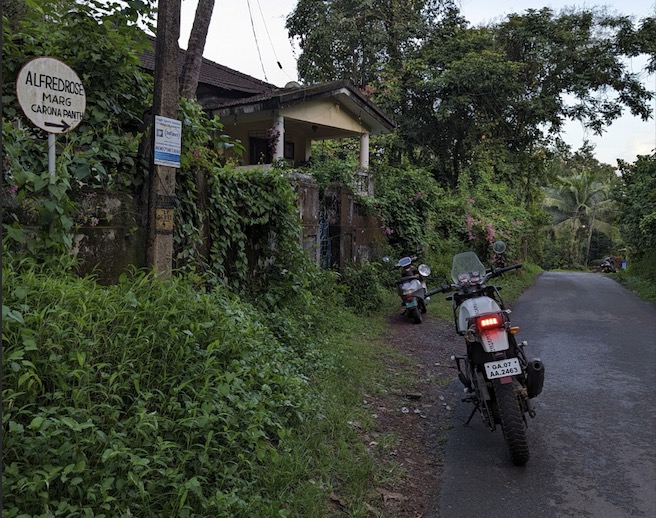
De Souza later visited Alfred Rose at his home in Bombay with the final version of the booklet to hand him a copy in person. When Alfred Rose was conferred with an award in Margao, by the Goa Government, De Souza was on stage and handed Alfred Rose a revised version of that booklet.
In August 2022, on the 90th anniversary of Alfred Rose’s birth, Dr. Glenis Mendonca, launched her book titled ‘The Rose Blooms – A Study of Alfred Rose’s Lyrics’; published by Dalgado Konknni Akademi. The bibliography of this book credits De Souza’s self published booklet on Alfred Rose as a secondary source.
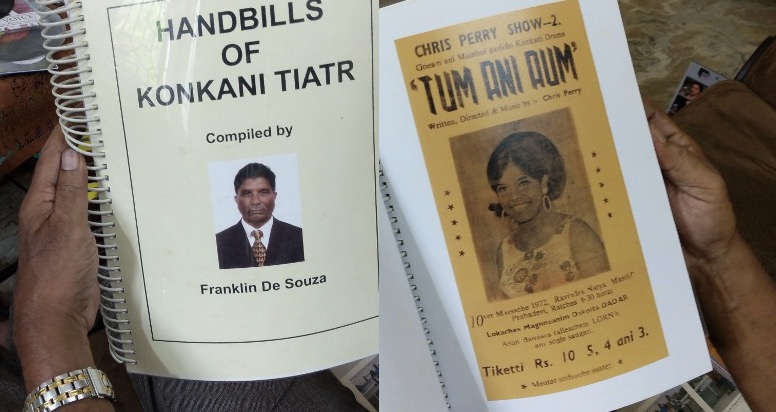
Aside from his work on Alfred Rose and Konkani records, De Souza also has an unpublished book of Tiatr handbills. These handbills were distributed in the villages whenever there was a tiatr being staged and he collected them over the years. Today, promotional handbills are not distributed and De Souza’s collection is a valuable piece of Goan culture and heritage. Holding this book of handbills in his hand, he acknowledged that it has been ten years since he last attended a tiatr. He has plans to submit a copy of this book of handbills to the Central Library in Panjim, so that students and researchers have access to it.
We ended the evening listening to a few records that I found which were not listed in the book. One such vinyl record was a Joe Rose LP that was also released on cassette. With a smile, De Souza said it was the first time he saw that LP in person and since the album was also on cassette, he wasn’t sure if there was a vinyl release. When I inquired if he’s considered releasing an updated version of the book, De Souza lamented that there aren’t too many readers for such books today other than researchers. But he is still making notes of the songs missing in the book.
When I asked De Souza how big a role music plays in the life of Goans, he laughed and said, “it’s like a glass of water after food“.
While signing my copy of his book, De Souza, a gazetted officer who retired 7 years ago, concluded by saying “Though I was a Civil Engineer working in the department, I kept my interest alive. Some people don’t have time while working and leave their interests, but I didn’t, and I still have the interest in me“.
The book ‘Konkani Gramophone Records’ is available for purchase at the Tiatr Academy of Goa, Campal, Panjim.
The self published booklet ‘Alfred Rose, Konkanni Palkache Maha Kolakar’ is out of print and can be found at the State Central Library, Patto, Panjim.
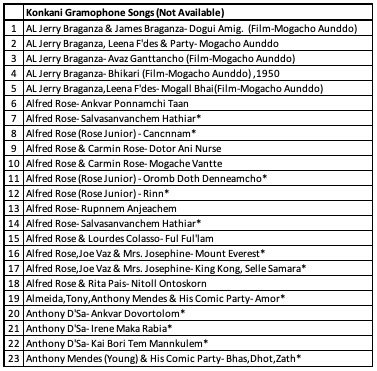
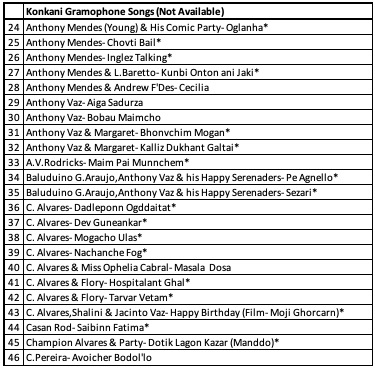
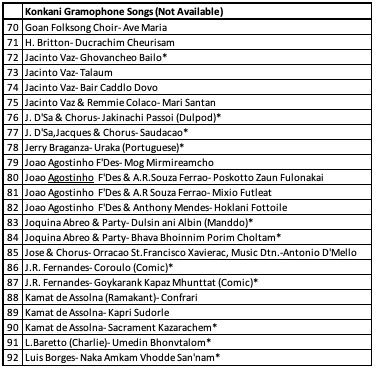
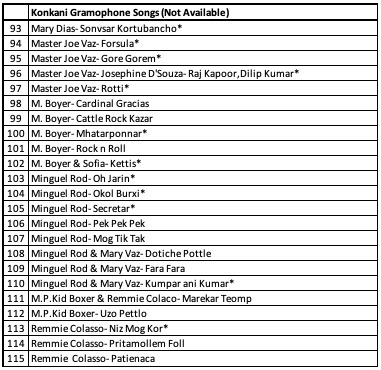
Here is a list of songs that De Souza has listed in the book but are hard to come by. Have you heard any of these Cantaram?


My gratitude to Edward bab Verdes for connecting me with Franklin De Souza.
 Kantaram
Leave a reply to Harriet Silva Vidyasagar Cancel reply