
Moldy Tapes from Goa #2
On International Jazz Day, I was fortunate to experience the Braz Gonsalves Quintet live and up close. After the concert, my mind wandered to a cassette I’ve long cherished. It made me wonder – how did jazz find its way into Goa’s vibrant music scene? For Moldy Tapes from Goa #2, this felt like the perfect cassette to write about next.
Let’s go back to the late 16th century, when King John III of Portugal required every Goan parish to have a school. Music was part of the Escola Paroquial (Parochial School) curriculum and shaped Goa’s cultural expressions; the Mando, Dulpod, Dekhni, and Cantaram. Students learned solfeggio and instruments like the violin, building a musical foundation beyond just playing instruments. By the 1860s, this tradition spread beyond Goa. The cotton boom in British Bombay drew young Goans seeking work and many found their rhythm in the city’s vibrant jazz scene.
Goan youth, with their innate flair for music, began migrating from their village parishes to the neighbouring city of Bombay. From Sebastian D’Souza (1906–1998; Reis Magos) and Chic Chocolate (1916–1967; Aldona) to Frank Fernand (1919–2007; Curchorem), Anthony Gonsalves (1927–2012; Majorda), Chris Perry (1928–2002; Borda), and Braz Gonsalves (born 1934; Neura) – they all traced a similar journey: from the humble Escola Paroquial of their villages to the glittering jazz clubs of British India.

Left to right – Sebastian D’Souza, Chic Chocolate, Frank Fernand, and Anthony Gonsalves
Beyond their roles in the subcontinent’s jazz scene, Sebastian D’Souza, Chic Chocolate, Frank Fernand, and Anthony Gonsalves left an indelible mark on Indian cinema. As arrangers for leading film composers, they reshaped the sound of Bollywood, blending Western harmony with Indian melody and, in doing so, transformed its musical identity. Chris Perry and Braz Gonsalves, however, charted distinctly different paths.
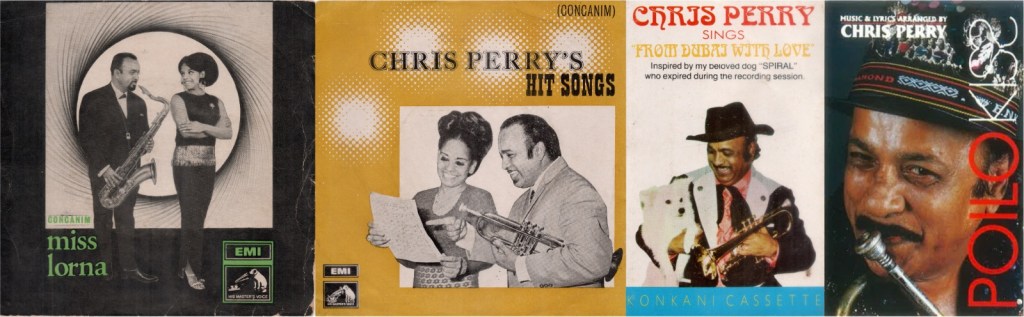
While Chris Perry also contributed to Bollywood, often without due credit, his heart lay in Konkani music. Known as The Man with the Golden Trumpet, he infused the Goan soundscape with jazz sensibilities, writing both lyrics and melodies. From the 1970s vinyl era to the cassette boom of the 1980s, he composed timeless hits for legends like Lorna, Usha Uthup, Seby Fernandes, and H. Britton; songs that remain beloved to this day. Perry stands as an icon of Konkani music.
Braz Gonsalves, in contrast, looked beyond Bollywood. Inspired by Indian ragas, he pioneered a form of jazz that wove together Indian classical and Western improvisation. His compositions, released on vinyl in the 1970s, carried him and his saxophone to international stages. A trailblazer of Indian jazz, Braz’s musical journey has been both innovative and far-reaching.
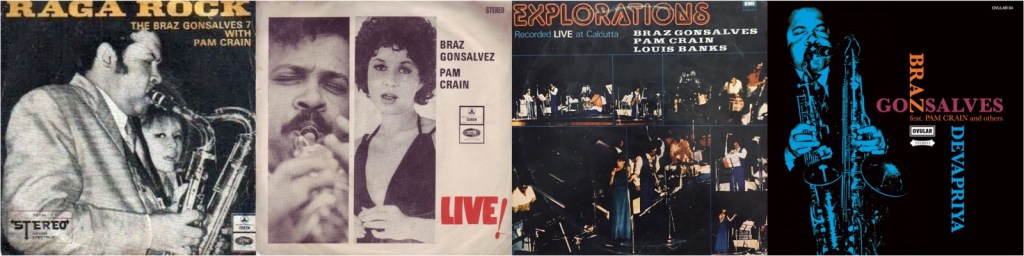
Accompanying him through the years has been his wife Yvonne Gonsalves, a jazz vocalist and daughter of the legendary Chic Chocolate (Antonio Xavier Vaz). Yvonne has performed in several of Braz’s ensembles, and together they continue to light up the Goan jazz scene.
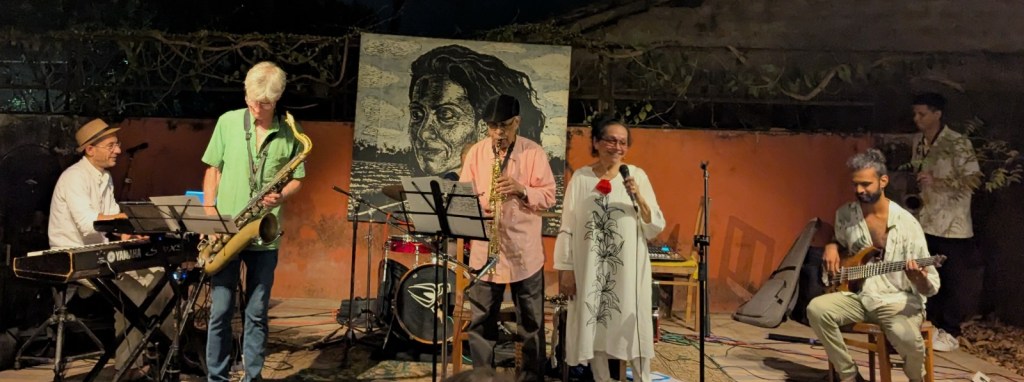
Despite their shared love for jazz, by the 1970s and ’80s, Chris Perry and Braz Gonsalves followed divergent paths that occasionally crossed.
I wrote this article a few months ago and later visited Braz and Yvonne to hear their side of the story. Our conversation began with Chris Perry and the moments when their musical journeys crossed.
Braz smiled as he recalled, “I didn’t play with Chris Perry much, but we were very good friends. He always liked me.”
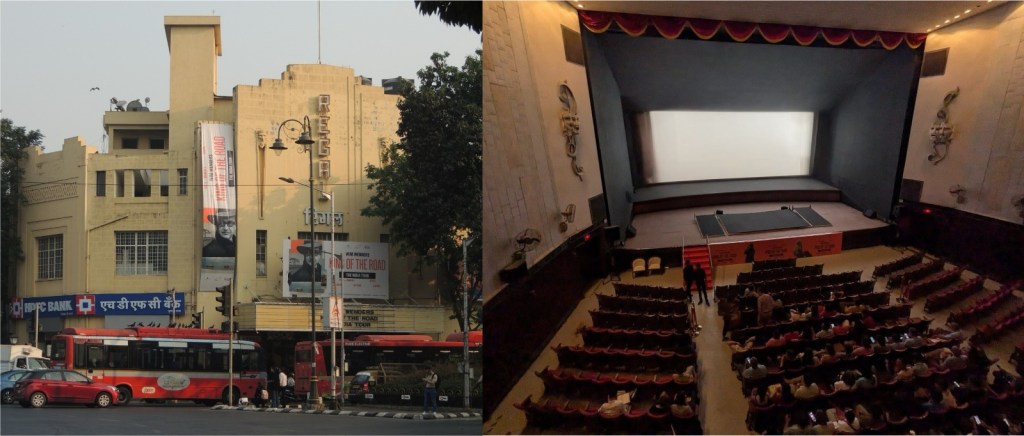
Yvonne added that while Braz and Chris never actually performed jazz together, there was one memorable concert at Regal Cinema in the 1970s where several jazz bands took the stage, including Chris Perry’s. Braz had just returned from Calcutta, and Chris invited him to join this show in Bombay. That night, Braz performed “You Don’t Know What Love Is.”
One of their early significant recorded collaborations was on Chris Perry’s Carnival in Goa, released on cassette in 1982. It featured Braz Gonsalves on a soprano saxophone solo for one of the tracks. Yvonne Gonsalves lent her voice to the opening songs on both Side A and Side B, but that’s a story for another time.
Jump forward to 1988, Chris Perry and Braz Gonsalves were invited to perform at the first International Goan Convention, organized by the Goan Overseas Association of Toronto (G.O.A. Toronto). The Gavana Folk Troupe was also part of the lineup for the grand event, held at Roy Thomson Hall.
Yvonne recalls those first few days in Toronto. Chris had planned the music he wanted to perform, but none of it had been written down. The accompanying band, a group of Canadian session musicians, needed sheet music to play along. So, late into the night, Chris and Braz would sit together, writing out Chris’ music note by note.
The success of the live performance inspired the idea to record the songs and release them on cassette. Given their remarkable individual achievements two decades earlier, the album was aptly titled The Legends. Recorded at Inception Sound Studios and Redline Studio in Toronto, it stood apart from the musical trends of 1980s Goa, offering something refreshingly different.
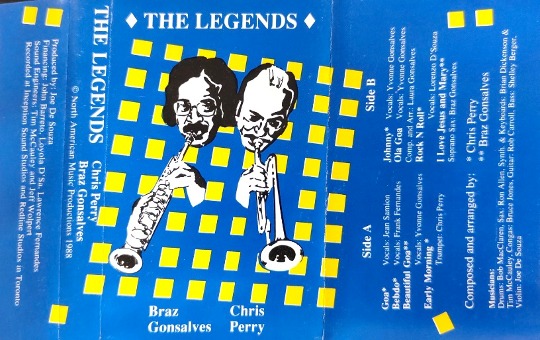
While the lyrics and themes remained deeply Goan, the sound was boldly experimental, spanning jazz, samba, reggae, and rock with hints of Goan folk music creeping in. Each track explored a new rhythm and style. Apart from composers Chris Perry and Braz Gonsalves, the musicians featured on the album were not Goan, adding yet another layer of diversity to this unique collaboration.
The album opens with a Chris Perry composition titled “Goa,” sung by Jean Samion, an Anglo-Indian vocalist. True to form, Perry once again worked his magic, just as he had with Lorna, Mohammed Rafi, and countless Bollywood playback singers before, guiding a non-Konkani speaker to sing beautifully in the Konkani language.
The song’s lyrics are in Konkani, with an English chorus that goes:
“Oh Goa, sweet little Goa,
Oh Goa, wonderful Goa,
You have such beautiful scenery,
Lovely mountains and trees, greenery,
Goa, I love you Goa.”
Judging by the lyrics, it seems likely that Perry composed the song especially for the Toronto event. The narrative tells of a girl born in Canada to Goan parents — someone who has never visited Goa. When she finally does, the experience feels dreamlike. Her parents, who have always given her everything, ask only one thing of her – to marry a Goan.
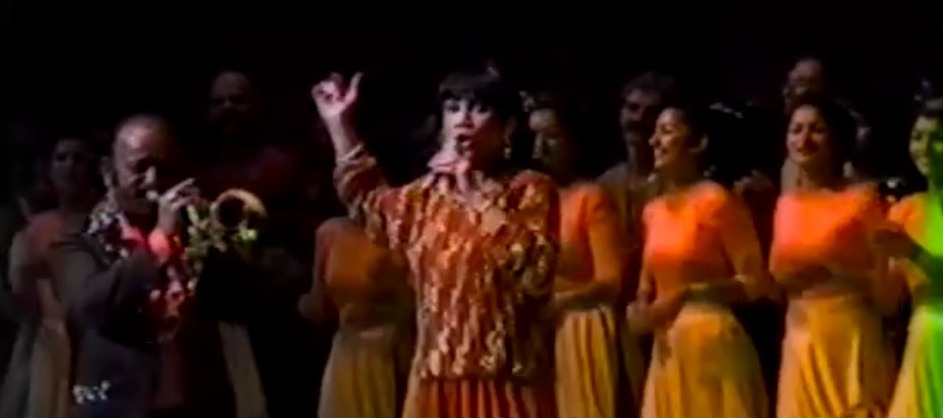
Chris Perry and Jean Samion at the International Goan Convention, Toronto – 1988. Credit G.O.A. Toronto
A video recording of the 1988 live performance recently resurfaced on the G.O.A. Toronto Facebook page, offering a rare glimpse of that unforgettable moment in Goan musical history.
The next track, “Bebdo” (Drunkard), instantly caught my attention. I had it on repeat for days after my first listen. Seeing the title, I initially assumed it was a cover of Chris Perry’s 1969 classic “Bebdo” performed by Lorna. But this turned out to be an entirely new composition, built around a reggae rhythm.
Surprisingly, midway through this Konkani reggae number comes a violin solo, an unusual choice, yet it blends seamlessly with the laid-back groove. Though the cassette credits the vocals to Frank Fernandes, the voice heard on the final tape is actually Chris Perry’s himself, giving the song a distinctive charm.
Up next is “Beautiful Goa,” composed and arranged by Braz Gonsalves, with vocals by his wife Yvonne and lyrics written by their daughter Laura Gonsalves, who was just 18 at the time. The song opens with a slow organ intro, playing the familiar Deknni melody “Aum Saiba Poltoddi Vetam.” Then it bursts into an upbeat samba rhythm, with Yvonne’s English vocals carrying the tune forward.
Pramod Kale, in his paper “TIATR: Expression of the Live, Popular Culture” (1999), notes that “the Dekhni, looks towards Hindu India for its inspiration, its lyrical themes and its costumes (the women dancers wear the traditional nine yard saris of the Hindus of Goa and the neighbouring Deccan (Maratha country). The music is Western, but the dance movements belong to the local traditions. Deknni is a romantic recreation of a past which, for members of the Goan aristocracy, was an ethnic memory more than anything else.”
Braz’s arrangement on this track is rich and layered with keyboards, synths, congas, and his unmistakable saxophone all shine through, creating a vibrant, modern groove. Braz recalls how he worked with pianist Brian Dickenson on the arrangement “I put that piece there,” he says. “I told him, you play it very modern. Let the melody stay. The Konkani melody will be there.”
Closing Side A is an instrumental piece titled “Early Morning,” composed by Chris Perry. The track instantly brought to mind his 1966 EP, which featured the instrumentals “Bombay Baion” and “Valentina’s Escape.” Yet, this composition carries a distinctly Spanish flavour.
It opens with the soundscape of a Goan dawn with church bells, a marching drum, and the distant crow of a rooster, an everyday scene brought vividly to life. From this tranquil beginning emerges Perry’s trumpet solo, marked by melodic phrases that evoke a West Asian influence, perhaps reflecting his years in Dubai, where he moved in the late 1970s.
With this track Perry crafts a smooth close to Side A, an eclectic side of the cassette where each of the four tracks dances to its own rhythm and mood.
Side B opens with “Johnny,” a Chris Perry composition featuring Yvonne Gonsalves on vocals. The lyrics flow seamlessly between English and Konkani, and Yvonne transitions between the two so effortlessly that you hardly notice the switch. I certainly didn’t, until I paid closer attention to the words.
Chris Perry was meticulous about the nasal Konkani tone and the precise pronunciation of every word with his vocalists. Yvonne recalled how, before the Toronto performance, he personally coached her on the diction of this song, ensuring that every syllable rang true and authentic.
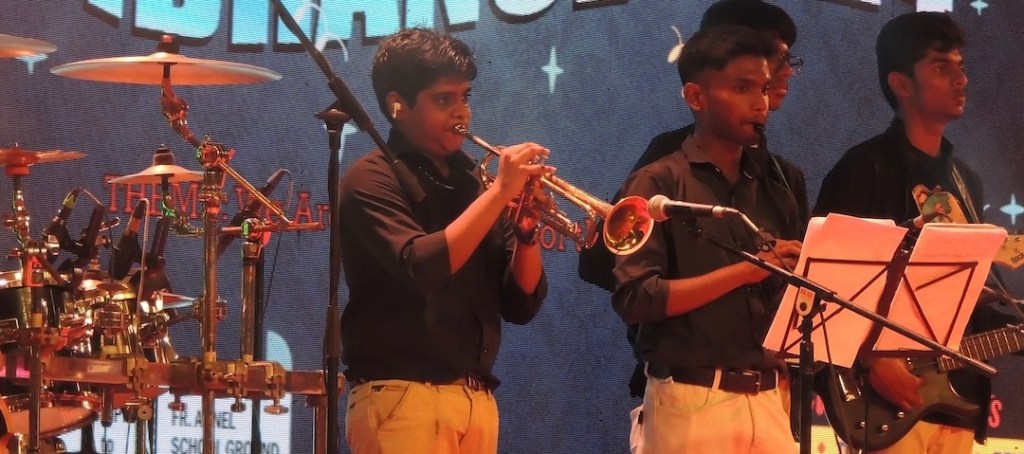
In December 2024, at Vibrance, the annual cultural show organized by Fr. Agnel Higher Secondary School, Pilar, the students brought new life to this classic. Tabitha Correa took the vocals, while Joshua de Agaçaim (Pereira) stepped in on trumpet, filling the role once played by Chris Perry. It was a rare and memorable moment, as the song came alive again 37 years after its release, carried by the youthful energy and pride of a new generation.
Pereira, a teenager active in Tiatrs and a multi-instrumentalists, shared with me that he truly enjoyed playing the trumpet fillers on “Johnny“. He represents a new generation of Goan trumpeters who are keeping the soul of Goan music alive.
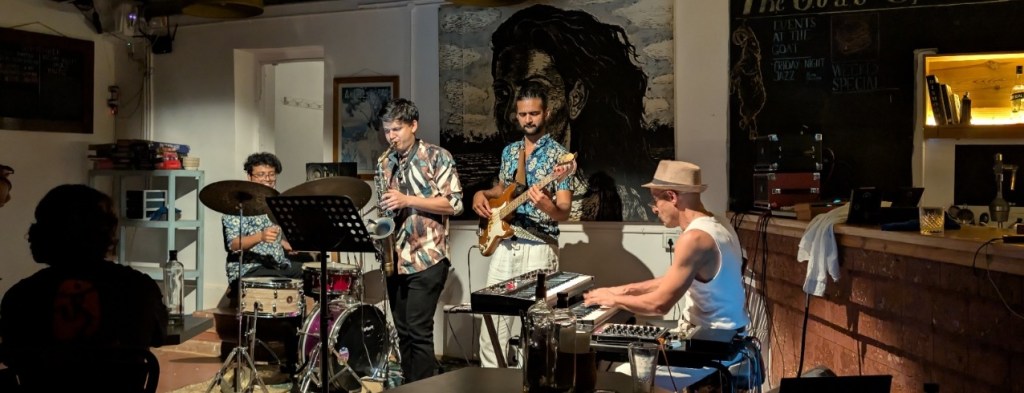
Jarryd Rodrigues, Braz’s grandson, continues the family legacy. After joining Braz on his comeback tour in Portugal, he’s now establishing himself as a promising voice in the modern jazz scene.
Next up is “Ola Goa,” another composition by Laura Gonsalves, daughter of Braz and Yvonne, with Yvonne on vocals. Braz recalls the song with pride:
“She wrote that song overnight — and what an intro she wrote! Very intricate, and it sounded fantastic. Not only that, she even had to write it down note by note for the pianist, Brian Dickenson. It was tough, but she did it.”
The track itself is a synth-heavy jazz number that perfectly reflects the musical style of its time, yet feels tailor-made for Yvonne’s voice.
Some of the standout lines from the lyrics read:
“We were waiting at the ferry, gazing at the sea,
Feeling heartily sorry for the bridge at Mandovi, Oh Goa, Goa.
The buses were so crowded and I could hardly breathe,
An experience that you and I and everyone would need in Goa, Goa.
I was in Vasco da Gama in my little shamiana,
Sipping at my feni, feeling nice and lovely, hey ça va Goa.
Went down to the flea market and bought a lot of stuff,
At night we dressed up freaky and we jammed up in the streets, Ola Goa, Ola Goa, Ola Goa.”
When I first heard the song, I tried to make sense of the lyrics. The line “feeling heartily sorry for the bridge at Mandovi” seemed to reference the collapse of the Mandovi Bridge in 1986. The mention of Vasco da Gama, not typically known for its party scene in the 1980s unlike Anjuna or Vagator, felt like a lyrical convenience. A rhyme more than a reflection.
But when I later spoke with Yvonne, the lyrics made more sense. Laura had written them based on her own memories of visiting Goa, moments drawn from real places and experiences. Yvonne shared that Laura would stay in Vasco da Gama during her visits, which explains the reference. And the phrase “ça va” which is French was simply a nod to Laura’s life in Canada.
Up next is a Rock ’n’ Roll number aptly titled “Rock and Roll,” composed by Chris Perry, featuring Lorenzo D’Souza on vocals and Ron Allen on saxophone. The track bursts with raw energy, sounding like a mash-up between Jerry Lee Lewis of the 1960s and Kiss of the 1970s but with Konkani lyrics.
A few years ago, during the pandemic, Silvia Fernandes, Aurvile Rodrigues, and The Warehouse Band revived this punchy tune in a spirited cover performance. If you don’t understand Konkani, you might miss the song’s playful satire. The lyrics praise the older dance styles like the Foxtrot and Rumba, while cheekily questioning the wild abandon of the Rock ’n’ Roll generation. Perry mocks the youngsters who grow their hair long, saying they look like circus monkeys, and pokes fun at their dance moves, swaying their hips for no reason, spreading their arms like falcons, or moving as if they’re driving a car or switching off the lights.
The song wraps up with a line claiming that today’s kids carry marijuana cookies in their pockets and smoke beedis (thin, hand-rolled cigarettes). A Rock ’n’ Roll song mocking Rock ’n’ Roll itself – that’s Chris Perry, the jazzman, at his most playful and subversive.
Concluding the tape is an instrumental jazz piece titled “I Love Jesus and Mary,” composed by Braz Gonsalves, featuring him on soprano saxophone. Thanks to Yvonne’s remarkable memory, I learned that Braz originally composed this piece for the wedding of his friend and bandmate Ashley Pinto in the 1970s. He first performed it publicly during the wedding mass at a church in Bombay. At the time, the composition was still untitled.
Years later, in 1983, during a concert in Macao held as part of the Macao Grand Prix, Braz performed before the Ruins of St. Paul’s. He recalls feeling a deep, spiritual energy flowing through him. A moment so profound that he felt compelled to kneel as he played. It was then that he named the piece “I Love Jesus and Mary.”
When the time came to name the track on The Legends cassette, Braz was advised to avoid the title, fearing it might affect sales. But he refused to change it.
Towards the end of the interview, as I sat beside Braz and played the song, he listened quietly and said, “This is meant to be played for the Lord.”
Yvonne then shared a moving story connected to this composition. “Chris Perry loved this song,” she recalled. “He told Braz, ‘You have to record this and when I die, I’d like you to play it at my mass.’ And he did.”
Braz remembers that day vividly, “I came from Bombay to Goa on holiday, but I carried my soprano. I was staying in Porvorim and he was in Salcete, Margao. Suddenly, I heard the news. Our friend Chris Perry had passed away. I said, I have to go. I went to the church in Margao, met his sons, and told them, ‘Your daddy told me to play this song at his funeral.’ And I played it, at the church, for the mass.”
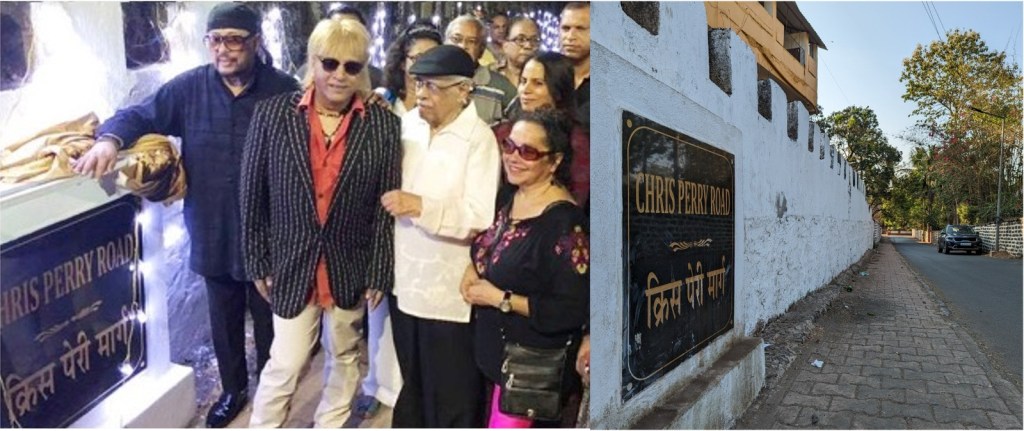
I’ve been fortunate to hear Braz Gonsalves perform a few times. From Neura to Bombay, to the world stage, Braz has had a remarkable career. Arguably the finest saxophonist to emerge from the Indian subcontinent, he remains one of the most influential figures in India’s jazz story. Now in his nineties, Braz continues to perform, switching between tenor and soprano saxophone with the same grace and passion that defined his early years.
This cassette stands as a remarkable milestone in the history of Goa’s recorded music. A fellow Konkani music aficionado once told me how he misplaced his copy while shifting houses and then went to the cassette store’s godown to hunt for another. This album is treasured by collectors and music lovers alike.
Together, Chris Perry and Braz Gonsalves placed Goa on the global jazz map and have found admirers far beyond Goa’s shores and diaspora circles. Their music endures, both timeless and borderless.
More than a rare recording, The Legends is a document of cultural continuity. It is a meeting of jazz sophistication and Goan sentiment which stands as testament to how musicians like Chris Perry and Braz Gonsalves carried Goa’s sound to the world, while still keeping its soul intact. Decades later, their music remains a touchstone for anyone tracing the roots of modern Goan identity through song.
 Kantaram
Leave a comment