
Part I of the Cassette Man of Goa series
While going through my cassette collection, I noticed that the name ‘Babush’ appeared frequently in the music credits. Printed on many J-cards was the line: Music: Babush. Several of these cassettes also featured spoken introductions, announcing the names of the lyricist, singers, and musicians. And time and again, as I listened, I’d hear the familiar phrase: Music – Babush.
There wasn’t a last name nor a mention of his real name. Another interesting observation was that Babush was the preferred choice of music arranger for many composers on their first cassette release. It seemed he was the go-to man for the job.
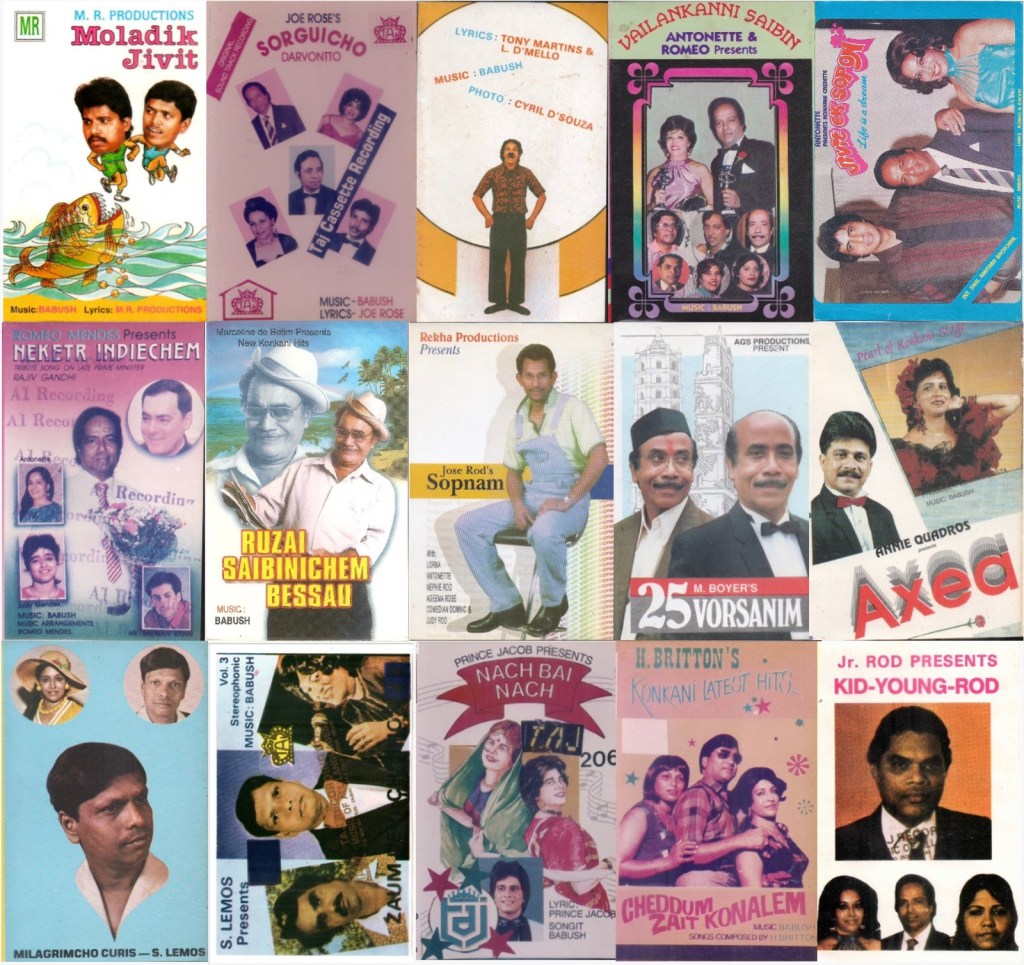
Music Babush, Music Babush, Music Babush but Babush Konn? I was curious to know more about the man who had composed and arranged music for all the big names of the Konkani music stage. At the end of this journey of discovery, I learned that Maestro Caridade Fernandes, contrary to his nickname Babush, which means ‘baby boy‘ in Portuguese, was a giant in the Konkani music scene.
Last September, during a conversation with another legend of the Konkani stage, Joe Rose, I mentioned that there was barely any information about Babush online, and I wanted to do something to change that. Babush was a bit of a mystery. Aside from a video of him being felicitated and a few news reports, there was almost nothing about him on the internet. Rose promised to provide me with a contact, and the next morning, I received a WhatsApp message with Babush’s phone number.
I immediately dialed the number, and to my surprise, Babush answered. We spoke, and I explained my intention to interview him at his home in Arambol. Unfortunately, he told me he was in Bomaim (Bombay) for the month and wouldn’t return until October. I offered to call again next month, and he ended the conversation with a kind “God bless you.” As I set a reminder on my calendar to call him at the end of the month, I couldn’t help but think how humble Babush, despite his impressive accomplishments, seemed over the phone.
At the end of the month, I called again and spoke with his daughter, Charmaine, who answered his phone. After sharing a bit about myself, we made plans for me to visit them in Arambol. She also introduced me to Benny, Babush’s son, who had performed with him over the years. Benny proved to be a treasure trove of information about Maestro Babush’s illustrious career. Part two of this series is based on my conversations with Benny Fernandes.
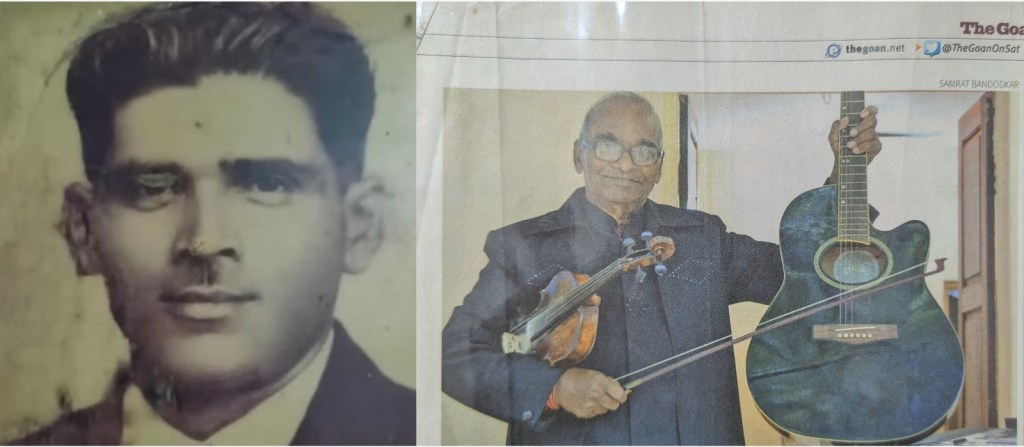
With great excitement, I drove up north to Arambol to meet Babush. I was welcomed by Charmaine, who graciously shared old photographs and newspaper clippings about her father. I was also fortunate enough to glimpse his handwritten sheets of music. Then, it was time to sit down and interview the Maestro himself.
Maestro Babush was born Caridade Fernandes on September 18, 1940, in the village of Arambol, Goa. He began learning music at a young age under the tutelage of Maestro Caetano D’Souza who taught music in the village. Over the years after moving to Bombay, he provided the music for hundreds of cassettes. I was meeting him now for the first time ever after he had just turned 84 two weeks ago. I had heard his music before but knew little about the man.
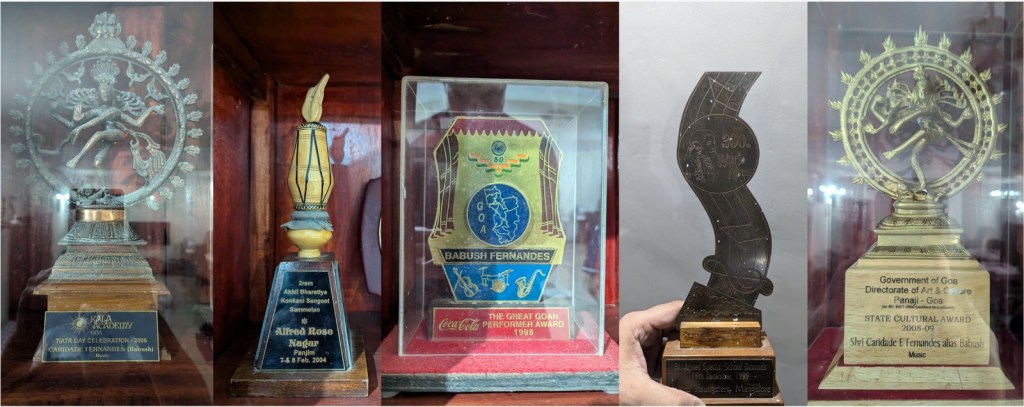
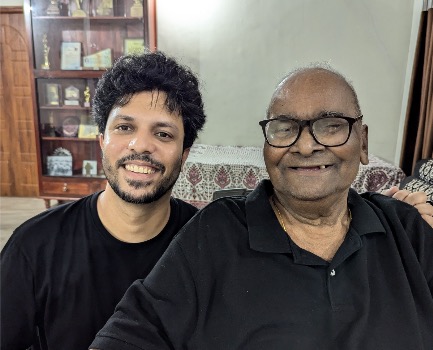
As I sat across from him in the hall of his home in Arambol, I couldn’t help but be struck by the cabinet behind him—filled with awards and honors he had received over the years. I knew I was in the presence of greatness.
Interview with Maestro Babush
(translated from Konkani)
Where are you from and when did you go to Bombay?
I was born in Arambol and grew up here. Soon after marriage I went to Bombay. Before that I was in Goa.
Your name is Caridade Fernandes, so how did you get the name Babush?
I got my grandfather’s name Caridade. They used to call me Caru. When I went to Bombay, Alfred Rose started calling me Babush. He got Mariano and me to play for him and he brought us together.
Where and how did you learn music?
Caetan Mistri (the Konkani term for Maestro) used make us sing in Latin and thought us how to write solfa.
What instruments do you play?
Alto, Tenor, Soprano, Violin and I used to also teach the neighbourhood children violin.
What’s your favourite instrument to play?
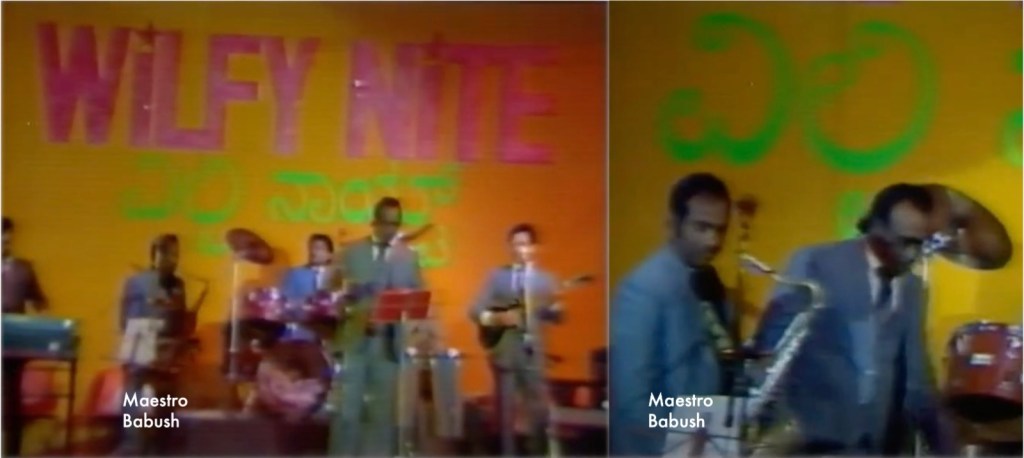
Tenor Sax. I played at the President Hotel and Gaylord Hotel in Bombay. In Bangalore at East West Hotel. I was not too sharp at Alto Sax, so they said take up Tenor and I took up Tenor. I played Tenor sax in the Gulf as well. We had many shows in Kuwait and Dubai too.
People say that you write music notes so fast as though you were writing a letter. How did that happen?
I initially wrote music for tiatrs. Later I went to Bombay and wrote music for the East Indians. They wanted music to be recorded quickly because it would turn out cheaper (studio time). So overtime I began to write quickly too, and they had plenty of songs.
What are your contributions to the Konkani music scene?
I wrote music for the video cassette of C. Alvares, for Alfred Rose along with Mariano too and for S. Lemos’ ten cassettes as well. I also wrote music for M. Boyer’s cassettes, C. Alvares cassettes, and for Rico too.
Before cassettes, did you record music for songs on shellac and vinyl?
Yes, I worked with Alfred Rose and most of the recordings were done in Bombay. Not a lot in Goa. Over here at Chris Correia’s studio, we used to go over for four days and I would complete the work within three days. The idea was that the track would come first, I used to sing over the track myself, not the actual singer. The singer would be called later. I would sing in solfa and build the track. I would use the organ, guitar and had a bass guitarist from Margao.
Who were the other musicians that you worked alongside with?
My three sons were in Bombay, and they would play the guitar, and I would play the Sax. Tony King used to play drums.
Did you teach your children music?
Yes, I taught them music.
Who were your favorites to work with?
Favourites as in? I enjoyed playing with everyone.
The era of cassettes came to an end due to piracy. What was your experience with piracy?
I once gifted a cassette to a man in Margao because he wanted the music. He went in, did something on the computer and retuned the cassette to me. When I said the cassette was for him, he said he didn’t need it. So, I said how can this work? What about those who are paying for the cassette? We have to spend a lot of money to produce one cassette. Because of such things I stopped working with cassettes.
I was thinking of setting up a studio here in Arambol, because my eldest son was also into recording. He had worked on Boyer’s album in Bombay. But we decided not to go ahead with those plans. What was the point of it? I told my son I don’t want to get into that business.
We use a lot of instruments in Goan songs, the sound of which instrument do you think is the soul of Goa music?
Trumpet, most people first look for the trumpet, everything else comes and goes. Chris Perry was a very good musician.
Did you ever feel that you should make a name for myself?
No, not when I was performing.
Because your name is on so many cassettes, people call you the Cassette Man of Goa.
ha ha (he laughs)
After the interview, I hummed a tune and Babush wrote down the notes for me. At 84 he is still quite fast, has a steady hand and quickly penned down what I was humming.
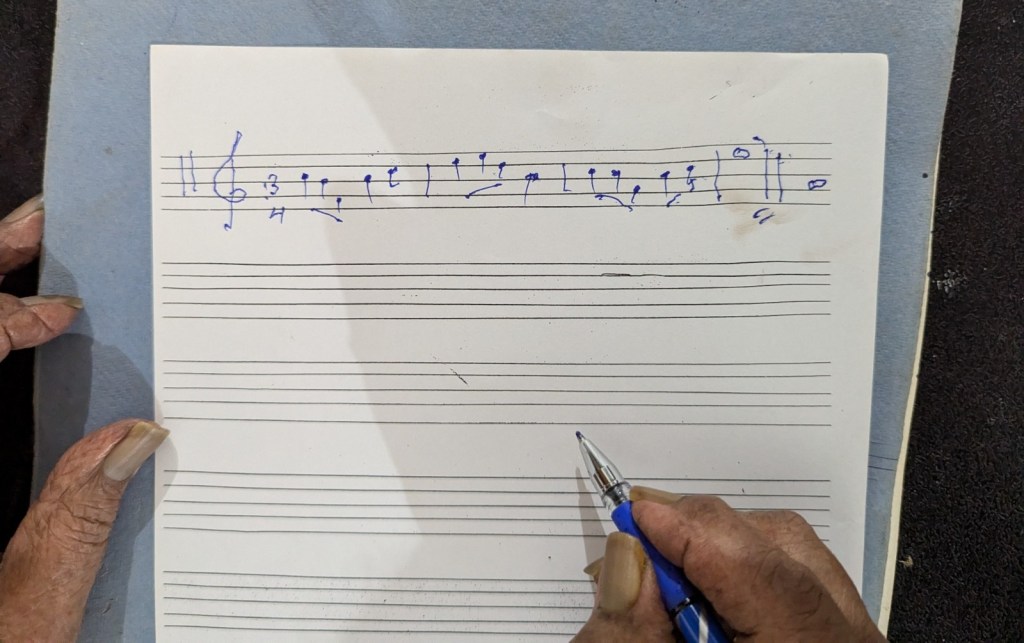
This interview of course is just the tip of the iceberg. At this age Maestro Babush doesn’t remember everything from the part of his life where he was busy churning out cassette after cassette for Goans, Mangaloreans and East Indians. After speaking with his son Benny and others in the industry, there is so much more to share.
On April 6, 2025, Maestro Babush passed away at his home in Arambol. Goa mourns the loss of a towering figure in Konkani music. Yet, the legacy of the Cassette Man of Goa lives on—preserved in hundreds of reels of tape and in the hearts of those who cherished his music.
 Kantaram
Leave a comment